Your app is more than just a product; it's a valuable resource that can be turned into profit. When you're ready to sell your app or bring in extra funding, it's important to dig deep and look at the situation from all possible angles. Keep in mind that understanding what drives an investor’s decision-making is equally as important. In other words, valuing an app correctly is crucial for both investors and founders, as it ensures confidence in the app's potential before the occurrence of any investment or purchase.
Together with Alon Waller from Bluethrone, a renowned app acquisition company, we decided to come up with this guide on how to sell an app. It covers key factors influencing subscription app valuation, how to calculate it, and ways to measure and optimize metrics that impact investors’ decisions. Plus, you'll gain valuable insights into what investors are willing to pay a premium for and what makes an app stand out to them.
Why Would Anyone Sell an App?
Now, the first question you might think of is why would anyone make the decision to sell an app? Well, it isn't just about making money; it’s often driven by significant life changes or business decisions. Here are some of the most common reasons why app owners might decide to sell:
Exhaustion from Ongoing App ManagementLet’s be honest, managing an app can be quite difficult and time-consuming. The constant need for updates, user support, and marketing can lead to burnout. If you’re worn out by the daily demands, selling might be the best way to cash out and move on.
Personal LifePersonal circumstances can shift unexpectedly. Whether it’s a new job, family responsibilities, or a change in priorities, sometimes stepping away from the project becomes necessary.
Team IssuesIf your team has broken up or lost its drive, maintaining the app’s quality and growth can become challenging.
3 Key Factors That Affect an App Valuation
When it comes to valuing your app, it’s easy to focus on individual metrics like churn rates or lifetime value (LTV). But the point is that everything is interlinked, and you need to see the bigger picture to get a real understanding.
Think of it this way: investors approach app valuation like detectives at a crime scene. They want to uncover the full story behind your app. They dig deep into the numbers to piece together what’s really going on and determine the app’s true value. So, as an app developer or owner, it’s crucial to not only track these metrics but also optimize them.
Here are three key factors to consider when deciding to sell your app:
Factor #1. Subscription App Growth
When you're figuring out how to sell apps online, the first thing you need to consider is whether your app is on the rise or losing steam. Take a look at the example below.
You can see there are two apps: one of them is app A, which brings in 567K a year, and the other one is app B, which makes 488K a year. Without going into the numbers and digging into all the metrics, it seems like both apps are doing well and probably work pretty much the same. But here’s the catch — it's not just about the total revenue. You need to dig deeper into what's called “new money” and “all money” or “renew money”. In other words, compare the growth from new users to the growth from returning users. This will give you a clearer picture of the app’s true potential.
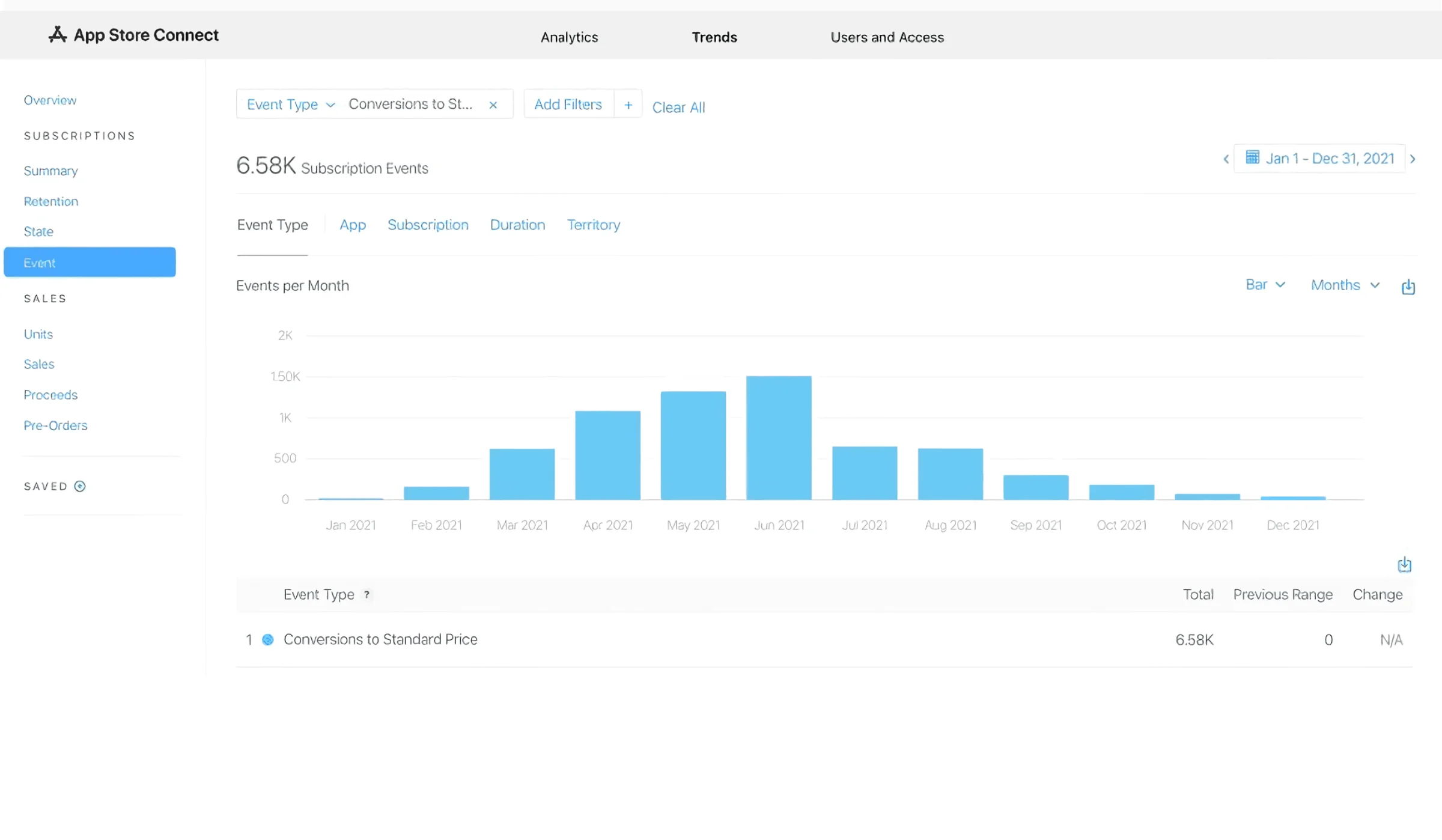
What we see here is that app A has only 5% of new money, which means that it relies on 95% of all app money. But not only the total amount that your application has attracted is important here, but also when there was an increase and what the level of growth is. Although app A makes 567K per year, app A can be considered as a dying app.
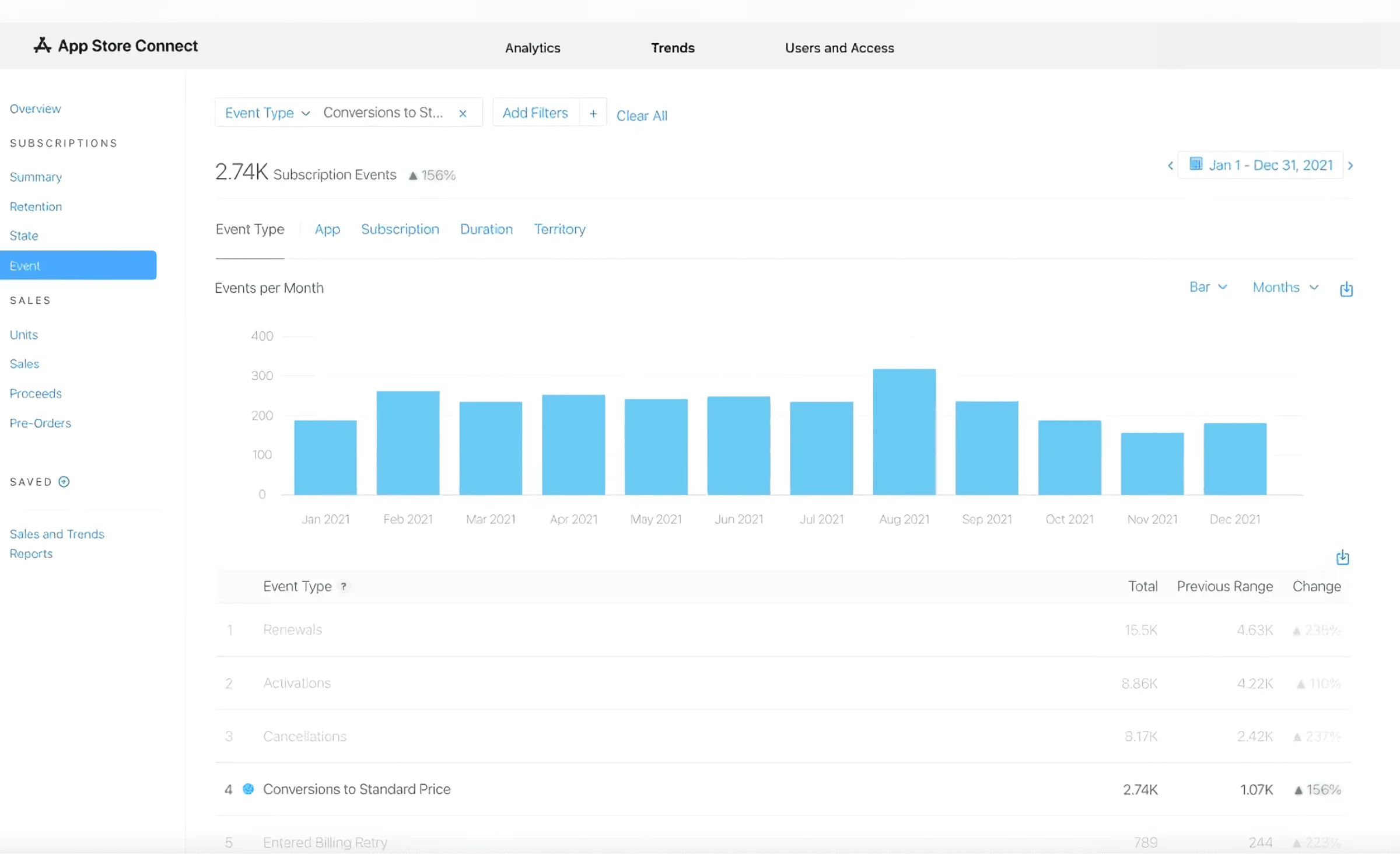
Let’s look at app B. It has about 50% of new money vs. old money. There is a good balance between the growth stages.
Such numbers, however, also depend on the life cycle of the app. If the app is starting to grow and just implement a subscription, the new money or activations can be 80% or even 90%. And the old money in this case will support the app and keep it going.
How to Measure Subscription App Growth?
Sometimes, app owners run into problems with getting the right KPI numbers or tracking key metrics because their analytics platform just doesn’t show them. But when it comes to app subscriptions, knowing details like new money, renewed money, and LTV is crucial. These indicators help you keep your app's growth on track at every stage, all the way to a potential exit. To get proper subscription app analytics, you need to install special analytic infrastructure, like Qonversion.
Qonversion allows you to differentiate two events for subscription started and subscription renewed, and like this, you can easily and instantly see the ratio between them and identify whether the app is growing or dying. Moreover, you can also get deeper and see how your app is doing in different countries using the country filter. In a few clicks, you can get crucial indicators and metrics. It’s important because if the app owner has everything already set up and ready to show to investors, it makes the process much easier.
Moreover, it also can help to create a better valuation because you can show the real data without any additional estimations through formulas, etc. that might hurt the app valuation itself.
Why Is the App Dying?
We found out that investors look at the new and old money to identify whether the app is dying or not, but what else can notify you about trouble?
Declining Niche
It is evident that if the niche is declining, all the apps from it will be dying too. No one wants to use applications that are not needed and irrelevant. No one wants to invest in or use apps that are becoming obsolete. Analyze your niche’s growth trends, see how your competitors are performing, and assess the competition level to gauge your app’s value.
Sudden Loss of Core Keywords
Investors also pay attention to the core keywords lists. And the more you rely on one keyword per one country on one platform, the more risk you have to lose it all. Therefore, you need to have a different core keyword list for each country and each of the stores. It allows investors to assess the level of risk and the less risk there is, the better valuation you’ll get.
Competition with better value or offer
Your app should fit the market demand. It should deliver real value, have a unique selling proposition, and be useful for users. Don’t just rely on a fancy API or create something that’s easy for others to copy. Make sure your app stands out and meets market demand in a meaningful way.
Unhappy paying users
When it comes to user satisfaction, positive reviews are a great sign that your app is hitting the mark and providing real value. On the other side, if you’re seeing a lot of negative ratings, that might be an issue. Investors will dig into these reviews and check their reliability. Surely some reviews are just spam and they are not taken into consideration.
Outdated onboarding
Onboarding process is important for customer retention and loyalty. Think of onboarding as your app’s first impression — if it’s clunky or old-fashioned, users might not stick around long enough to become paying customers and there will be a big churn, which is alarming to investors. Keeping your onboarding fresh and user-friendly is key to turning installs into loyal, paying users.
Factor #2. Subscription App Optimization
Let's dive into our next key factor: the three-step subscription funnel: downloads – free trial – activations.
When investors are considering purchasing an app, these are the metrics they analyze closely. They want to understand how healthy the app is, how well it monetizes, and how eager users are to pay and subscribe. For example, if an app has 1,600 daily downloads, and the free trial conversion is 13.9%, which means from this 1,600, 13.9% converting to free trial. Then users start using your app, and the activations from them are 30%. The benchmark for a good health indicator for a subscription app is beyond the 10% conversion to free trial and 30% and above for the activation to become a paid user.
Let’s see what happens if we optimize it. Suppose your yearly subscription is $6.99, and you’re pulling in 1,600 downloads with a 13.9% free trial conversion and a 30% activation rate. That adds up to a daily revenue of $466. Now we increase each indicator by 10%.
We will now get 1,760 downloads, and the conversion will be 15%. The activation increased to 33%, resulting in $621 in revenue. A tiny 10% increase in each of the three sub funnel steps equals a 33% increase in revenue. Not bad, don’t you think?
Factor #3. The Insane Power of Multipliers
Now, let’s talk about the third factor: the incredible power of the multiplier. This ties right into what we just covered.
We now have $621 from this 10%, 10%, 10% optimization. The most common multiplier is 36 months. However, you can have it be even more or less, depending on the essential metrics and how healthy your app is.
Let’s calculate the original app valuation. Remember, we had 466$ daily revenue, and then we multiplied it by 30 days to get $13,980 in monthly revenue. We multiplied the monthly revenue by 36 months (that is our multiplier). Therefore, we get $503,280 for the app before optimization.
Then once we slightly optimize the app and make the same calculations, the valuation jumps to $670,680.
You can even get a 20% increment for each indicator with good optimization, and it will give you an 73% increase in revenue. Use A/B testing of different onboarding screens and prices. It is a great instrument for experimenting and identifying the best performing options.
Let’s go back to our example. We slightly increased the price (from $6,99 to $7,99) and a 20% app optimization. After all calculations, we now have almost 1 million dollars in app valuation. That is the insane power of multiplier—a tiny 10% to 20% app improvement can actually double your exit package.
What Else Affects App Valuation
Investors look at a lot of different factors when buying an app, and it can vary from one investor to another. But if you want to have a high valuation for your app, this is the bare minimum on top of everything else we’ve already discussed:
Listing optimization
Listing optimization is what investors look at first. If the listing is optimized and converts from impression to download and your app is not from the risky niche, like dating apps or casino apps, the valuation increases.
Investors also look at the Apple Search Ads campaigns and the optimization. Having some keywords that actually convert downloads to activations and to paying users increase your app value.
Market Size and Recent Trends
Investors should understand the size of the market you’re in. An unknown niche can lower your app valuation as it might not be in high demand. As for the trends, make sure that you're selling an app when the trend is growing and not starting to deep dive.
AI predictions
Usually, investors use AI predictions on top of the current numbers. It helps them to better understand what will happen with these trends, with these numbers, with this LTV, and where the app will grow.
App age
App age is also an important factor for app valuation. Because, for example, if your app is young and about three month old, it’s better not to sell it and focus on its optimization and growth. The more the app is operating stable, the higher valuation it will have. Your app should be at least 6 month old, but still 12 or 18 month will say more about the stability of the app, and you will get a higher valuation.
Offer conversion rate
Offering code conversion rate is a crucial metric for investors. It shows how many unique users react to your offers and actually convert. Moreover, it’s not only saying a lot of things about the product or the offer. It also says a lot of things about the customer: if he’s willing to pay or maybe he has some better solutions out there.
How to Sell an App: The App Sale Process
Now that we’ve covered pretty much all there is on app valuation, let’s proceed with the app selling process itself. How to sell an app to a company?
To break it down, the app valuation process typically takes about 21 days. It kicks off with the first stage, where there's a quick overview of your app’s metrics—basically a preliminary look without diving too deep into the numbers.
Next, we move to the deep valuation stage. This is where you’ll get an official offer from an app acquisition company, and you’ll walk them through how your app works. At this point, you’ve got two choices: either you can decide to sell, or if there are areas that need improvement, you can work on those and come back later.
After the suggested improvements, you can come back in 90 days or in a year. If you’ve optimized your app effectively, you’ll be in a good position to sell. The final step is closing the deal and moving on to the exit.
Wrapping up
If you’re a subscription app owner with high profits and a proven track record of successful app growth, sooner or later you will think about selling your app, and for this, you need to know how much your app is worth. In this article, we offered the most basic attributes of high valuation that can be applicable to every app and provided guidance on how to sell an app. However, as we indicated above, it’s not easy to evaluate each app for every scenario because each app requires a detailed understanding of its unique complexities and operates in different environments. Therefore, exit-planning is the long-term consideration that should be well planned, and when you are ready to sell an app, your app should be in the best position possible.
If you’re already considering selling an app, it’s time to delve into your core metrics. You can use Qonversion to track your subscription data, our tool that is very-well fitted for any investors’ eyes. Also, to receive a quote for your app, please don’t hesitate to reach out to the Bluethrone team.

Hena
Copywriter at Qonversion
Hena crafts compelling content about mobile app monetization and subscription optimization.