At $25K MRR, many apps stall. Growth becomes unpredictable. Acquisition costs rise, retention cracks appear, and the once-steady feedback loop turns into noise.
So, if our previous session was about building momentum, this one’s about building systems.
On October 2, our CEO, Sam Mejlumyan, and Nick Laz, Business Development Executive, hosted a webinar on this topic — and here’s the full recap.
The $25K Plateau: When Growth Starts to Break Your Systems
At $25K MRR, you’re no longer proving that your product works — you’re proving that your systems do.
This is the point where founders realize growth isn’t linear. The more you scale, the more fragile your economics become.
Three signs you’ve hit the plateau:
- You’re spending more on acquisition but your payback window is stretching
- Churn quietly eats up 20–30% of new revenue each month
- Experiments take longer to show results, and wins feel smaller
The fix? System thinking. Instead of chasing new installs, start refining what you already have. As Sam put it:
>
“You don’t scale chaos. You scale clarity.”
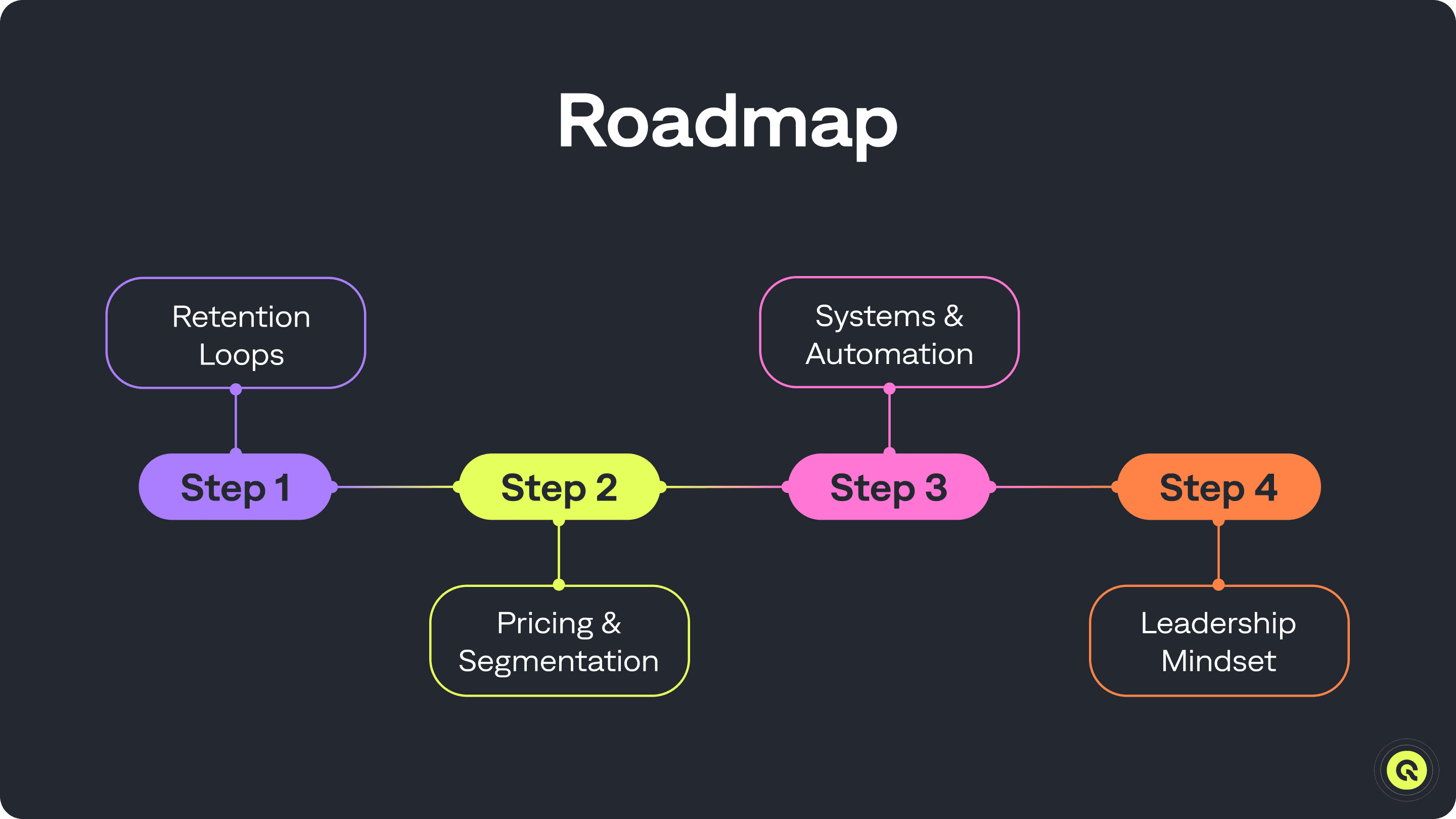
Retention First: Stop Losing What You Already Earned
“Retention is your best growth engine — because it’s the only one that doesn’t cost you more,” said Nick Laz.At this stage, even small retention lifts can drive outsized returns.
Improving D30 retention from 6% to 9%, for example, compounds into a 20–30% MRR gain within a few months — without touching acquisition.Retention playbook at $25K–$100K MRR:
- Measure NRR (Net Revenue Retention): Aim for >100%. Below that, you’re treading water.
- Automate lifecycle messaging: Push, in-app, email — consistent nudges increase engagement by up to 25%
- Enable Refund Keeper and track refund rates: Anything above 3,5% signals value or UX friction
- Extend billing grace periods: Recover up to 25% of failed renewals
Retention is less about adding features and more about tightening feedback loops.
Or, as Sam said:
>
“Most teams build for acquisition, not for retention — but retention is what buys you the right to scale.”
Monetization: Build Value, Then Charge for It
At $10K–$25K, pricing is an experiment.
At $25K–$100K, it becomes your strongest lever.“The question isn’t how much you charge, it’s how much value users think they’re getting.” – Nick explained.That’s where value-based pricing comes in — aligning your tiers, trials, and paywalls with what users actually perceive as worth paying for.Monetization checkpoints:
- Test annual plans (they cut churn by ~30–40%)
- Plan your grandfathering strategy — when updating prices or plans, decide whether existing users keep old rates, as poorly handled migrations can trigger 10–15% churn among loyal subscribers
- Simplify paywalls — one clear “best value” option beats five confusing ones, create and test it with No-Code Builder 2.0
- A/B test trial lengths — 3-day vs 7-day trials can swing conversion by up to 20%
- Always test messaging — small copy shifts (“Start free” → “Try all features”) can lift CTRs by 10–15%
The key is iteration — not just on pricing, but on positioning.
“Pricing is never finished. Every new user segment deserves its own experiment.” – as Sam summarized.
Acquisition: Predictability Over Volume
At $25K MRR, acquisition math changes.
The cheap installs are gone. Algorithms evolve. Attribution is murkier than ever.“What worked before $25K won’t necessarily work after,” Sam warned. “Developers get stuck here because their acquisition systems don’t evolve with their scale.”Instead of chasing volume, the focus shifts to predictability — measuring what’s working, cutting what’s not, and investing in compounding channels.Practical benchmarks:
- CAC payback: Aim to recover costs within 12 months
- ROAS tracking: Don’t rely solely on SKAdNetwork — use Qonversion’s Apple Ads attribution for keyword-level precision
- Custom Product Pages (CPPs): Improve conversion by +15%
- Smart banners / deep links: Add +20% conversion from web-to-app traffic
And automation is your friend here.
Systems & Leadership: From Hustle to Discipline
“You can’t micromanage your way to $100K MRR,” Sam said. “You need systems that make decisions for you.”This is where founder roles shift:
- From doing to delegating
- From reactive fixes to proactive reviews
- From intuition to data discipline
Practical steps:
- Build a dashboard that updates key metrics (MRR, churn, CAC, LTV) daily
- Automate reports — no more “manual Monday updates”
- Create ownership: assign one owner per key metric
The founders who scale smoothly are the ones who stop chasing fires and start building infrastructure that prevents them.
Wrap-Up: Scaling Smarter, Not Harder
Going from $25K to $100K MRR isn’t about magic levers — it’s about stacking small, predictable wins:
- Retain more → earn compounding revenue
- Price better → unlock perceived value
- Automate systems → scale predictably
Each of these layers amplifies the others.
And the fastest way to build those layers? Shortcuts that save you time.Qonversion helps you move faster — with No-Code Builder, A/B testing, and analytics that actually makes sense.Book a Demo and let’s turn your next growth stage into a predictable system — not a guessing game.

Vlada
Marketing Manager at Qonversion
Vlada drives marketing initiatives at Qonversion, connecting with the mobile app community.