If an Apple Ads (formerly Apple Search Ads) campaign has shown fewer payers and a lower ROAS since September 2026 while organic grew, check two things: ad groups with age or gender settings, and ad groups where Apple set an age limit you didn't; Apple hasn't said whether that blocks attribution too.
The cause is a change in Apple's AdServices attribution: since September 2026 it returns attribution = false for installs from ad groups with age or gender settings. The install still happens and its cost stays in your spend, but your analytics gets the same answer as for an organic user. So the ad group shows spend and no attributed payers. Its revenue lands in organic. A campaign that mixes such ad groups reports a lower ROAS than it earns. That's the campaign you'd cut.
Apple doesn't send the attribution, so no analytics tool can recover it, ours included. The revenue is still yours. Only the label changes. If the setting isn't essential, remove it. If it is, move those ad groups to a campaign of their own.
What changed in Apple Ads attribution in September 2026?
In September 2026, Apple stopped returning attribution to your app for installs from ad groups with age or gender settings. AdServices is the Apple API your app or SDK asks, after an install, which ad led to it. Its changelog has one line dated "September, 2026": the payload will return "attribution = false for campaigns using age or gender targeting." Apple gives the month; measurement partners date it September 1.
The help article Measuring performance of ads on the App Store states the rule at the ad group level and shows the whole payload you receive when age or gender settings are on:
{ "attribution": false }
No campaign, ad group, keyword or click date. Just false. Apple's article gives user privacy as the reason.
The changelog says campaigns. The help article and the response codes in the attributionToken() reference say ad group, where age and gender settings live. This article follows the ad group reading; moving demographic ad groups into a campaign of their own works under either.
Why do Apple Ads installs show up as organic since September 2026?
Because an ad group with age or gender settings now gets false, and false is also what Apple returns when it finds no ad behind an install. In the attributionToken() reference, if the API "can't find a matching attribution record, the attribution value is false." Two different installs, one answer. Your analytics can't tell them apart.
So a tool that reads AdServices files a false user as organic, along with their trial and every renewal. If an ad group with age or gender settings shows installs in your Apple Ads console (Apple's reports can still count them, one measurement partner notes) and zero attributed users for installs from October on, this change is the likely cause.
How much does one demographic ad group distort campaign ROAS?
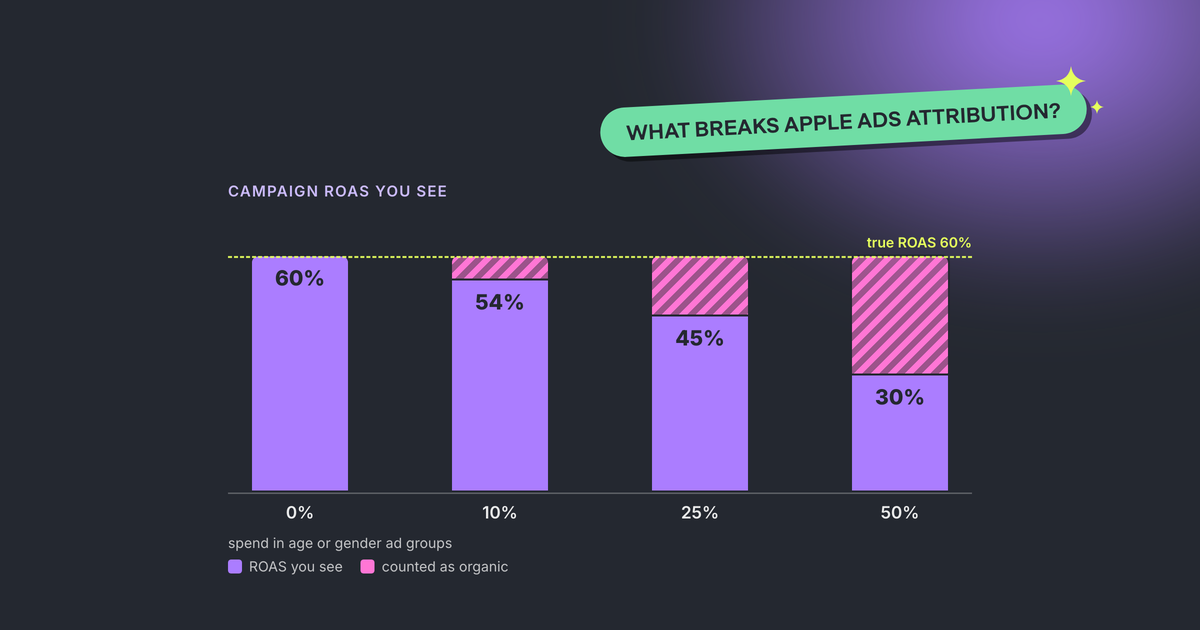
Campaign ROAS falls in proportion to the share of spend in demographic ad groups: if a quarter of a campaign's spend goes there, the ROAS you see is a quarter lower, so a campaign that earns 60% shows 45%. That holds if those ad groups earn like the rest.
Assumptions for the table below (Illustrative numbers, not data from any account):
- One campaign, $10,000 of spend in the period, 50 paying users if every install were attributed.
- Every ad group in the campaign earns the same D30 ROAS (revenue in the first 30 days after install, per dollar of spend), 60%, and brings the same paying users per dollar of spend.
- The app gets no attribution for these installs from any other source.
| Share of campaign spend in age or gender ad groups | Campaign D30 ROAS you see (true: 60%) | Revenue reported as organic instead | Cost per paying user you see (true: $200) |
|---|---|---|---|
| 10% | 54% | $600 | $222 (+11%) |
| 25% | 45% | $1,500 | $267 (+33%) |
| 50% | 30% | $3,000 | $400 (+100%) |
The formula: the ROAS you see equals the true ROAS times (1 − s), where s is that share of spend. Cost per paying user is multiplied by 1 / (1 − s).
The error is largest where you act. A campaign that shows 45% instead of 60% looks like the one to cut. If bid rules run on cost per paying user or ROAS, exclude demographic ad groups from them, or their keywords will read as zero-payer keywords and get cut. Their zero is missing data, not a result.
Organic looks better than it is, by the same dollars. Any organic-versus-paid or before-and-after comparison carries the error: for a campaign with demographic ad groups, October install cohorts show fewer Apple Ads payers and more organic ones than August cohorts, even if demand didn't change. If you use a mobile measurement partner (MMP), read its notes on the September 2026 change: some MMPs began applying lookback windows to Apple Ads claims, which alone can lower attribution slightly.
Calendar revenue lags: if your tool doesn't let a later false erase an earlier Apple Ads attribution, users attributed before the change keep it, renewals and redownloads included. Compare full-month install cohorts, August against October, over the same window for both — D30, say — and read October only once that window has closed.
How do you find ad groups with age or gender settings?
Check the demographics part of every ad group's audience settings in the Apple Ads console. Through the API, look for minAge, maxAge or gender in the ad group's targeting in the Apple Ads Platform API, or for age and gender in targetingDimensions in the Campaign Management API v5. Apple's rule names only age and gender, not location or other audience settings. Read each setting back: Apple can set an age floor of its own.
That's where to look. Your data confirms it:
1. Take each ad group with spend in a period that starts in October 2026, so no installs attributed before the change mix in.
2. Put Apple's install count next to the users your analytics attributes to it. At keyword level, compare only keywords you bid on: Search Match installs come without a keyword ID in any ad group.
3. Flag ad groups with a meaningful number of installs on Apple's side and zero attributed users (a handful can show zero by chance, or because those users never opened the app). A demographic setting is the first suspect. A missing AdServices token is the second, but it hits every ad group while it lasts: @VynseDev launched campaigns before his app collected the token, and by his account, those first installs are "data I can never tie back to a keyword."
4. Repeat at campaign level. A campaign with spend and no attributed users at all has a demographic setting in every ad group, or a wider collection problem.
Look for zero, not a gap: your attributed count can even exceed the Apple Ads console's. On Apple's developer forums, a developer who reinstalled an app about 15 minutes after deleting it, without a new ad tap, got attribution: true for the original keyword.
Should you remove age and gender targeting from Apple Ads?
For most subscription apps, yes. A demographic setting now costs you twice: in reach and in measurement.
Apple's audience settings article already warns that age or gender refinements exclude everyone with Personalized Ads turned off. By Apple's figures, those devices produced 78% of App Store search volume on iOS 17 and later (FY24, across all countries and regions with Apple ads). So, on that average, a demographic ad group reaches at most 22% of that search volume. And since September, you can't see who it brought in.
Removing the setting reopens the ad group to people with Personalized Ads off, so check the daily budget and bids first: spend can rise sharply. Apple attributes installs up to 30 days after a tap or 24 hours after a view, so treat the first 30 days after the change as mixed and judge the ad group on what follows.
Keep the setting only where you need it, for example when your app's rating is below Apple's automatic 18+ limit and you must not advertise to minors. With All Ages selected, Apple says you may reach users under 18. In that case, isolate the setting:
- Recreate demographic ad groups in a campaign of their own. Neither Apple Ads API has a field for moving an ad group to another campaign, so you build new ones: they get new IDs and start with no history. The rest of your account stays measurable. Apple also advises keeping a campaign for all eligible users next to any campaign with modified audience settings.
- Measure the isolated campaign by what it adds. Pause it for two weeks, or run it in alternate weeks, keep everything else flat, and compare total new payers, paid plus organic, in the countries it covers. The difference is approximately what the campaign brings; payers lag installs, so read it a conversion window after the pause ends, not on its last day. Use Apple-side cost per install only as a guard against overspending.
Does Apple's automatic 18+ age limit turn off Apple Ads attribution?
Not confirmed yet, but you can test it: see which age setting your ad groups read back. Apple's audience settings article says ads for apps with a "15+ or higher" rating serve only to users 18 or older (or the local minimum age), "even if you don't set any age refinements." Under Apple's global App Store age ratings for iOS 26 and later (4+, 9+, 13+, 16+ and 18+), that reads as apps rated 16+ or 18+; 15+ itself exists only in Korea's regional ratings.
Apple can also set an age floor your rating doesn't explain, so an ad group without an age setting may not exist. Indie developer @CtabDev, whose app is rated 4+ in the US App Store, tried to clear the 18+ setting through the API: by his account, the API accepted the change, but the setting read back as 18, the minimum Apple's eligibility data lists for his app. On Oct 20, 2026, he wrote that his attribution "comes back false bc of the 18+ age setting on the ad group." That's one developer's experience; Apple hasn't confirmed that this floor turns off attribution.
If an ad group reads back with no age setting, run the four-step check on it: attributed users there mean the limit doesn't trigger the rule. If all read back 18+ and none shows attributed users while the SDK sends tokens, ask Apple Ads support, and meanwhile judge the channel by total new payers.
Can an MMP or AdAttributionKit recover missing Apple Ads attribution?
No, not at the ad group or keyword level, and this answer covers Apple Ads only.
An MMP reads the same source: Apple's reference lets you hand the AdServices token to an MMP or call the API yourself. Either way, a demographic ad group gets false.
AdAttributionKit doesn't fill the gap either. In it, Apple Ads appears as com.apple.ads, with one campaign ID per placement: 10, 20, 30 and 40 for search results, the Search tab, the Today tab and product pages. That's the placement, not the ad group or keyword. And Apple's measurement article and attribution overview say Apple Ads registered with AdAttributionKit on April 10, 2025, starting with SKAdNetwork versions 1.0–3.0, and will adopt the AdAttributionKit API itself at a later date. Whether or not the age and gender rule applies there, plan on placement-level data from that side, at most.
The tracking prompt Apple announced for EU users in iOS 27.2 doesn't change this: Apple's measurement article says "AdServices does not engage in tracking" as App Tracking Transparency defines it. If EU numbers move, check ad group settings and your SDK first.
What should your analytics show for Apple Ads spend without attribution?
Spend without attribution should be visible as its own line, not shown as a $0 return. A blank tells you the number is unknown; a zero tells you to cut.
The Apple Ads report in Qonversion is built that way: Apple's spend and the users your analytics attributed to it are reported side by side, campaign by campaign and ad group by ad group, so spend with nothing attributed to it reads as a missing number rather than a bad one. The documentation covers what each level reports. Before you cut a mixed campaign, open its ad groups.
Sign up, connect Apple Ads and add the SDK's attribution call. The Apple Ads console counts installs; from then on, the Apple Ads report in Qonversion also shows which of your ad groups bring attributed payers and which of them bring none.

Vlada
Marketing Manager at Qonversion
Vlada drives marketing initiatives at Qonversion, connecting with the mobile app community.