We at Qonversion.io have recently released a cohort analysis for our users. It feels like the right time to provide some overview of leveraging cohort analysis to make better decisions for your subscription app.
What is cohort analysis?
A cohort of users is just a set of users grouped by specific characteristics. For example, you can group users in cohorts by country, the average time they spend on your app, or the time they started using it. By analyzing the different metrics of a cohort, you can better understand it and even predict some of its valuable attributes, like retention or future revenue.
How to do cohort analysis for a subscription app?
In the case of a subscription app, it’s crucial to understand how a cohort of subscribers acquired during a specific time period renews their subscriptions as time passes.
By looking into renewals over consecutive subscription periods, you can understand how good your app is at retaining subscribers. You can get to the Lifetime Value (LTV) estimates when you know, on average, how many subscribers renew their subscriptions in each consecutive period. You can take a look at our article on calculating mobile subscription LTV. Cohort analysis provides a view into the crucial parameter for the LTV calculation – subscriber retention.
It is also beneficial to filter and analyze cohorts separately by country, specific subscription duration, marketing acquisition channel, and other parameters. All these segments may have significantly different subscription renewal rates.
What is a reasonable subscriber retention rate for a subscription app?
It depends on many factors, including your app category, the subscription duration, the country mix of your user base, and many others. In any case, there will likely be a significant churn in the first few months. You can expect roughly 40-60% of subscribers to churn during the first subscription period. An additional 20-30% of subscribers will likely churn in the consecutive 1 or 2 subscription periods. Users who do not use your app a lot are naturally canceling the subscription in the early stages. As more time passes, users who have yet to unsubscribe are less likely to unsubscribe.
How can user retention in a mobile app be improved?
To have high subscriber retention, you should consistently deliver some value to your users. It’s good to make regular updates to your app, adding new valuable features. You can also experiment with the duration of your promoted subscriptions. Other important aspects are churn prevention and winning back users who lapsed by using push notifications and emails with promotional offers.
What is ARPU, and how does one calculate ARPU?
ARPU is the average revenue per user. In other words, it’s how much revenue, on average, each user brings. In the case of a subscription app, it makes sense to look at ARP(P)U – average revenue per paying user (subscriber). This metric shows how much income an average subscriber brings over time. You need to divide a cohort’s cumulative revenue by the initial number of subscribers in this cohort to arrive at ARP(P)U. You can see your actual ARP(P)U for monthly cohorts of subscribers in Qonversion.
Closing thoughts
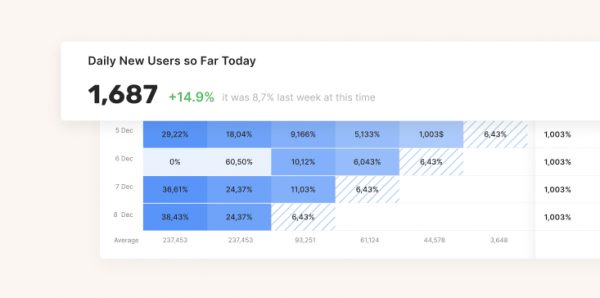
Cohort analysis, including subscriber retention and ARP(P)U, is crucial to power subscription app growth. Qonversion already provides you with a detailed dashboard for subscriber cohorts. Here is a preview of cohorts you’ll get for your app in Qonversion:

Michael
CEO at Qonversion
Michael leads Qonversion with a vision to help mobile apps maximize their subscription revenue.