Annual Recurring Revenue (ARR) is a key financial metric that helps gauge the health of your subscription model. In this guide, we'll explore what is ARR, how to calculate ARR, and delve into what ARR means in finance. Understanding ARR is essential for your growth, as it highlights trends in your recurring revenue streams. Let’s get to it!
What is ARR
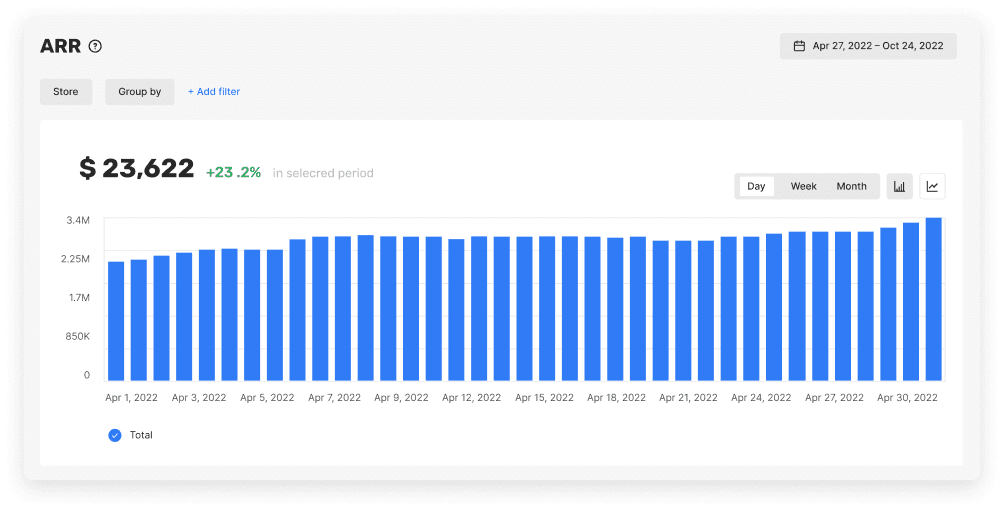
ARR, or Annual Recurring Revenue, is a key performance indicator (KPI) commonly used by subscription-based businesses to measure the value of their recurring revenue streams. ARR represents the total value of all active subscriptions over a given year, offering a snapshot of a business’s predictable revenue. Businesses that understand what does ARR mean and how to calculate ARR can monitor their growth, forecast future revenue, and make data-driven decisions.
One of the main benefits of using ARR as a metric is that it provides a clear and consistent way to track the growth of a business over time. By comparing ARR from one period to another, businesses can easily see whether they are gaining or losing subscribers, and can adjust their strategies accordingly.
In addition to tracking the growth of a business, ARR can also be used to forecast future revenue and identify trends in the market. For example, if a business is seeing a decline in ARR over time, it may be an indication that the market is becoming saturated or that the product is losing its appeal. On the other hand, if ARR is steadily increasing, it could be a sign that the business is gaining market share and could potentially be a good time to invest in expansion or new product development.
The difference between ARR and MRR
Both Annual Recurring Revenue (ARR) and Monthly Recurring Revenue (MRR) are financial metrics that measure the amount of revenue a company can expect to receive on a regular basis. However, the key difference between the two is the time frame over which the revenue is measured.
ARR measures the amount of revenue a company can expect to receive on an annual basis from its subscription-based services. When trying to learn how to calculate ARR, it is important to do it by multiplying the number of paying customers by the average price of the company’s products or services, and then multiplying that number by the number of years in the subscription term.
In contrast to ARR, MRR measures the amount of revenue a company can expect to receive on a monthly basis from its subscription-based services. It is calculated by multiplying the number of paying customers by the average price of the company’s products or services, and then that number is divided by the number of months in the subscription term.
For example, if a company has 100 paying customers, each paying $100 per month for a 12-month subscription, the company’s MRR would be $12,000. The company’s ARR would be $12,000 x 12 months = $144,000.
Both ARR and MRR are important financial metrics for companies operating in the subscription-based business model, as they provide a predictable and stable source of income. However, MRR is typically used to track the short-term performance of a company, while ARR is used to track long-term performance and growth potential. We encourage you to read our other article to learn more on what is MRR.
How to calculate ARR
There are a few different ways on how to calculate ARR, and it depends on the specific needs of each business. However, one common method is to take the total number of active subscribers and multiply it by the average revenue per subscriber (ARPPU) for a given period.
ARR = Total Number of Active Subscribers x ARPPU
For example, if a business has 1,000 subscribers paying an average of $50 per month, the ARR would be $50,000 per month or $600,000 per year.
ARR Movement
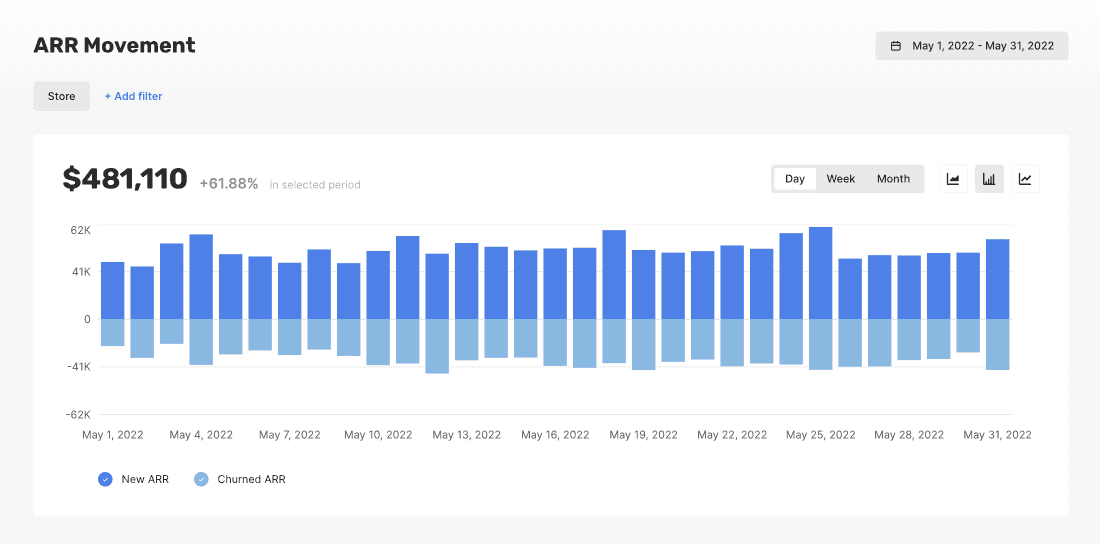
ARR Movement, also known as ARR Churn or ARR Net Change, is a financial metric that measures the change in a company’s Annual Recurring Revenue (ARR) over a specific time period. It is calculated by subtracting the ARR at the end of the period from the ARR at the beginning of the period, and is typically expressed as a percentage.
For example, if a company’s ARR at the beginning of the month is $100,000 and its ARR at the end of the month is $110,000, the company’s ARR Movement for that month would be $10,000, or 10%. A positive ARR Movement indicates that the company’s ARR has increased over the period, while a negative ARR Movement indicates a decrease in ARR.
ARR Movement is an important financial metric for companies operating in the subscription-based business model, as it provides insight into the performance and growth of the business. A positive ARR Movement can be a sign of a healthy and expanding business, while a negative ARR Movement may indicate that the company is losing customers or experiencing pricing pressures. By tracking and analyzing ARR Movement over time, companies can make informed decisions to drive growth and long-term success.
ARR and Its Uses in App Monetization Strategy
ARR serves as a crucial metric for subscription apps, and overall, for companies operating under a subscription model. Here’s how businesses can leverage ARR to enhance their strategies
Measuring App Growth
When it comes to growth, ARR is a key indicator of how well a company is doing. The stability and predictability of ARR make it an ideal metric for tracking progress. By comparing ARR over multiple years, companies can get a clear picture of whether their strategies are working. ARR assesses a company's performance in particular aspects, highlighting areas of revenue growth or decline and the underlying reasons for these changes.
Assessing Business Model Effectiveness
ARR assesses a company's performance in particular aspects, highlighting areas of revenue growth or decline and the underlying reasons for these changes. ARR focuses on the recurring revenue generated through subscriptions.
Customer Retention Insights
Looking at ARR gives businesses a clearer picture of how well they’re keeping customers. By spotting trends in subscription renewals, companies can come up with strategies to boost customer happiness and keep them from leaving.
Strategic Pricing Models
Tracking ARR allows businesses to experiment with different pricing strategies, such as tiered subscriptions or promotional offers. This flexibility can help optimize revenue while catering to diverse customer needs and preferences.
Gaining Investor Interest
Investors typically gravitate toward companies with solid ARR because it shows they’re stable and have room to grow. Emphasizing ARR can make a business more attractive to investors, making it easier to secure funding for expansion or new projects.
How to track ARR for mobile apps
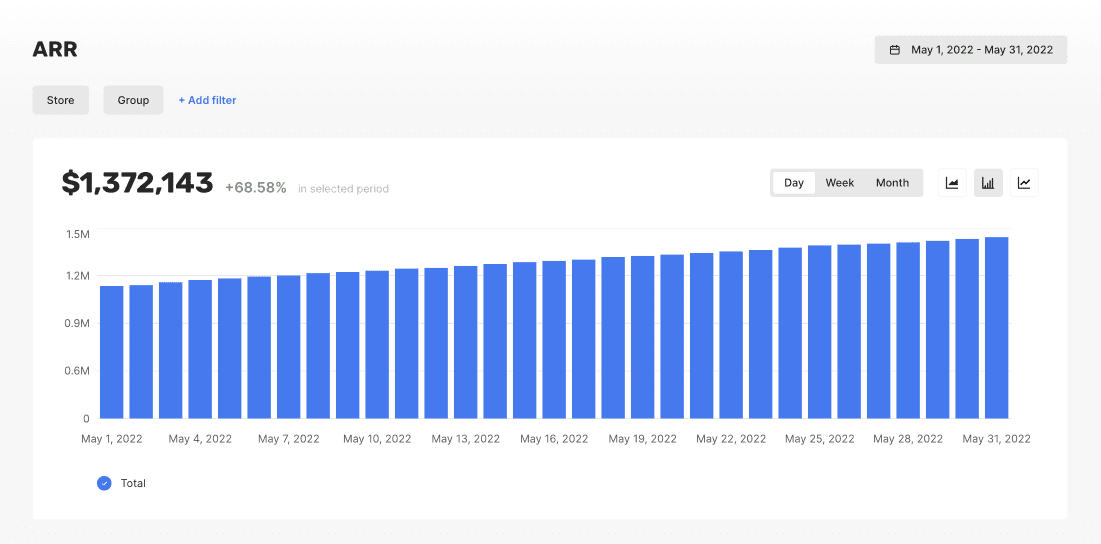
By using Qonversion for ARR reporting, companies can connect their subscription billing and payment data to the platform. Qonversion will then automatically calculate the company’s ARR and other key metrics, and provide detailed reports and charts to help the company understand its financial performance and growth.Beyond ARR reporting, Qonversion offers plenty of features to help businesses manage and optimize their subscription model. You can track subscription churn trends, access real-time dashboards, and use automatic revenue recognition, all designed to give you deeper insights. The best part? All the main subscription charts are available for free, making it easy for you to get started and see your ARR data in action

Kate
ex. Head of Marketing at Qonversion
Kate led marketing at Qonversion, building the brand and community around subscription app monetization.